
De-identification
Starting from version 2604, Aidbox supports per-column de-identification in ViewDefinitions via a FHIR extension. When a column has a de-identification extension, the SQL compiler wraps the column expression with a PostgreSQL function that transforms the value before it reaches the output.
This works with all ViewDefinition operations: $run, $sql, and $materialize.
Requires fhir-schema mode. ViewDefinitions are stored in the FHIR Artifact Registry — on upgrade Aidbox migrates existing ViewDefinitions from legacy storage automatically; new and updated ViewDefinitions are read from FAR by $run, $sql, and $materialize.
Extension format
Add the de-identification extension to any column in the select array:
{
  "name": "birth_date",
  "path": "birthDate",
  "extension": [
    {
      "url": "http://health-samurai.io/fhir/core/StructureDefinition/de-identification",
      "extension": [
        {"url": "method", "valueCode": "dateshift"},
        {"url": "dateShiftKey", "valueString": "my-secret-key"}
      ]
    }
  ]
}
The extension uses sub-extensions for the method and its parameters. The method sub-extension is required and specifies which de-identification method to apply.
Methods
redact
Replaces the value with NULL. No parameters.
{"url": "method", "valueCode": "redact"}
cryptoHash
Replaces the value with its HMAC-SHA256 hash (hex-encoded). Deterministic — same input always produces the same hash. One-way, cannot be reversed.
| Parameter | Type | Required | Description |
|---|---|---|---|
| cryptoHashKey | string | yes | HMAC secret key |
[
  {"url": "method", "valueCode": "cryptoHash"},
  {"url": "cryptoHashKey", "valueString": "my-hash-key"}
]
dateshift
Shifts date and dateTime values by a deterministic offset derived from the resource id. All dates within the same resource shift by the same number of days, preserving temporal relationships. The offset range is -50 to +50 days.
Year-only values ("2000") and year-month values ("2000-06") cannot be shifted meaningfully and are replaced with NULL.
| Parameter | Type | Required | Description |
|---|---|---|---|
| dateShiftKey | string | yes | HMAC key used to compute the per-resource offset |
[
  {"url": "method", "valueCode": "dateshift"},
  {"url": "dateShiftKey", "valueString": "my-shift-key"}
]
birthDateSafeHarbor
Intended only for Patient.birthDate. Behaves like dateshift but returns NULL when the birth date implies the patient is over 89 years old, per HIPAA Safe Harbor rule 45 CFR 164.514(b)(2)(i)(C).
Applying this method to any other date column is semantically incorrect — the function computes age(current_date, input) and treats the input as a birth date. Use plain dateshift for non-birth-date fields.
Because the function depends on current_date, it is marked STABLE rather than IMMUTABLE — PostgreSQL guarantees it returns the same result within a single transaction, but the result may differ between transactions as the current date changes. This means the age cutoff re-evaluates on every query.
| Parameter | Type | Required | Description |
|---|---|---|---|
| dateShiftKey | string | yes | HMAC key used to compute the per-resource offset |
[
  {"url": "method", "valueCode": "birthDateSafeHarbor"},
  {"url": "dateShiftKey", "valueString": "my-shift-key"}
]
encrypt
AES-128-CBC encrypts the value and returns a base64-encoded string. Reversible with the key. Uses a zero initialization vector for deterministic output — same plaintext always produces the same ciphertext.
| Parameter | Type | Required | Description |
|---|---|---|---|
| encryptKey | string | yes | Hex-encoded key. Must be 8–32 hex characters of even length (validated by the StructureDefinition at compile time). AES-128 expects 16 bytes / 32 hex characters; shorter keys are accepted but provide weaker security and are not recommended for production data. |
[
  {"url": "method", "valueCode": "encrypt"},
  {"url": "encryptKey", "valueString": "0123456789abcdef0123456789abcdef"}
]
Key management. Cryptographic keys (cryptoHashKey, dateShiftKey, encryptKey) are stored as plaintext strings inside the ViewDefinition resource. Anyone with read access to the ViewDefinition can see the keys. Restrict access using AccessPolicy.
Encryption limitations. encrypt uses AES-128-CBC with a zero initialization vector. Encryption is deterministic — same plaintext always produces same ciphertext, which is useful for consistent de-identification but leaks frequency information. Not suitable for general-purpose encryption.
substitute
Replaces the value with a fixed string.
| Parameter | Type | Required | Description |
|---|---|---|---|
| replaceWith | string | yes | Replacement value |
[
  {"url": "method", "valueCode": "substitute"},
  {"url": "replaceWith", "valueString": "REDACTED"}
]
perturb
Adds random noise to numeric values. The result is non-deterministic — each query produces different output.
| Parameter | Type | Required | Description |
|---|---|---|---|
| span | decimal | no | Noise magnitude. Default: 1.0 |
| rangeType | code | no | fixed (absolute noise) or proportional (relative to value). Default: fixed |
| roundTo | integer | no | Decimal places to round to. 0 means integer. Default: 0 |
With fixed range type, noise is in the range ±span/2. With proportional, noise is ±(span × value)/2. Any other rangeType value raises a SQL error.
[
  {"url": "method", "valueCode": "perturb"},
  {"url": "span", "valueDecimal": 10},
  {"url": "rangeType", "valueCode": "fixed"},
  {"url": "roundTo", "valueInteger": 0}
]
custom_function
Applies a user-provided PostgreSQL function. The function must already exist in the database. Its first argument is the column value cast to text. An optional second argument can be passed via custom_arg.
| Parameter | Type | Required | Description |
|---|---|---|---|
| custom_function | string | yes | PostgreSQL function name. Must match ^[a-zA-Z][a-zA-Z0-9_.]*$ |
| custom_arg | any primitive | no | Optional second argument, passed as a FHIR sub-extension using the appropriate value[x] type: valueString, valueInteger, valueDecimal, valueBoolean, or valueCode |
[
  {"url": "method", "valueCode": "custom_function"},
  {"url": "custom_function", "valueString": "left"},
  {"url": "custom_arg", "valueInteger": 4}
]
This example uses the built-in PostgreSQL left function to keep only the first 4 characters (e.g. extracting just the year from a date string).
See also: Writing custom PostgreSQL functions
Example ViewDefinition
A complete ViewDefinition that de-identifies Patient data:
{
  "resourceType": "ViewDefinition",
  "id": "deident-patients",
  "name": "deident_patients",
  "status": "active",
  "resource": "Patient",
  "select": [{
    "column": [{
      "name": "id",
      "path": "id",
      "extension": [{
        "url": "http://health-samurai.io/fhir/core/StructureDefinition/de-identification",
        "extension": [{
          "url": "method",
          "valueCode": "cryptoHash"
        }, {
          "url": "cryptoHashKey",
          "valueString": "patient-hash-key"
        }]
      }]
    }, {
      "name": "gender",
      "path": "gender"
    }, {
      "name": "birth_date",
      "path": "birthDate",
      "extension": [{
        "url": "http://health-samurai.io/fhir/core/StructureDefinition/de-identification",
        "extension": [{
          "url": "method",
          "valueCode": "dateshift"
        }, {
          "url": "dateShiftKey",
          "valueString": "date-shift-key"
        }]
      }]
    }]
  }, {
    "forEachOrNull": "name",
    "select": [{
      "column": [{
        "name": "family",
        "path": "family",
        "extension": [{
          "url": "http://health-samurai.io/fhir/core/StructureDefinition/de-identification",
          "extension": [{
            "url": "method",
            "valueCode": "redact"
          }]
        }]
      }]
    }]
  }, {
    "forEachOrNull": "address",
    "select": [{
      "column": [{
        "name": "postal_code",
        "path": "postalCode",
        "extension": [{
          "url": "http://health-samurai.io/fhir/core/StructureDefinition/de-identification",
          "extension": [{
            "url": "method",
            "valueCode": "substitute"
          }, {
            "url": "replaceWith",
            "valueString": "000"
          }]
        }]
      }]
    }]
  }]
}
In this example:
idis replaced with a consistent hashgenderpasses through unchanged (no extension)birthDateis shifted by a deterministic offset per patientname.familyis redacted (NULL)address.postalCodeis replaced with "000"
The result from the $run operation would look like this:
id | gender | birth_date | family | postal_code |
|---|---|---|---|---|
| a9c063ce560ab35c2156d4bf153457d8c7b0ad6325c1c4112b34eb7147aaa8f9 | female | 1985-03-02 | null | 000 |
| 6e7dfba4a51c359ead0afd9e3ff542c9417505957bf374e510eb37ec020fbc12 | male | 1952-11-12 | null | 000 |
| 27fb6fd29c5657c1a122aa1ae28cdfc5e10b202c6dc7d498cec72609b3a1b447 | female | 1930-05-08 | null | 000 |
Materialization restriction
A ViewDefinition that contains any de-identification extension can only be materialized as a table. Attempting to materialize as view or materialized-view returns HTTP 422 with an OperationOutcome:
This restriction exists because PostgreSQL stores the full view definition (including the compiled SQL with embedded keys) in pg_views.definition and pg_matviews.definition. Any user with SELECT on those catalogs would see the cryptoHashKey, dateShiftKey, or encryptKey values in plaintext. Tables materialize the transformed data only, leaving the keys inside the ViewDefinition resource itself (which is access-controlled).
$run and $sql are unaffected — they return data or SQL strings directly without storing anything in system catalogs.
AidboxMaterialization builds views and materialized views only, with no table option, so a run on a de-identified ViewDefinition fails. That check covers materialized nodes alone: Aidbox inlines a de-identified ViewDefinition without an AidboxMaterialization of its own into the object of any dependent that has one, keys included. Keep de-identified ViewDefinitions out of dependency graphs you materialize.
Pre-built ViewDefinitions
The IG package io.health-samurai.de-identification.r4 provides ready-made Safe Harbor ViewDefinitions for common FHIR R4 resource types. Install it via Artefact Registry ("FHIR packages" in Aidbox UI):
| Resource | Use |
|---|---|
| Patient | Uses birthDateSafeHarbor on birthDate, cryptoHash on id, redact on name/address identifiers |
| Encounter, Condition, Observation | dateshift on clinical dates, cryptoHash on references |
| Claim, ExplanationOfBenefit | dateshift on billable periods |
| AllergyIntolerance, DiagnosticReport, MedicationRequest, MedicationDispense, MedicationAdministration, Immunization, Procedure, Specimen, DocumentReference | Same general approach |
| Practitioner, Location | Identifier redaction |
Install the package via FHIR package management and use these ViewDefinitions directly, or copy and customize them. Every cryptographic key parameter in the pre-built VDs is blank ("") — you must set real keys before using them for actual de-identification.
Using the UI
The ViewDefinition builder in Aidbox UI includes a de-identification picker on each column. Click the shield icon next to a column's path to open the configuration popover.
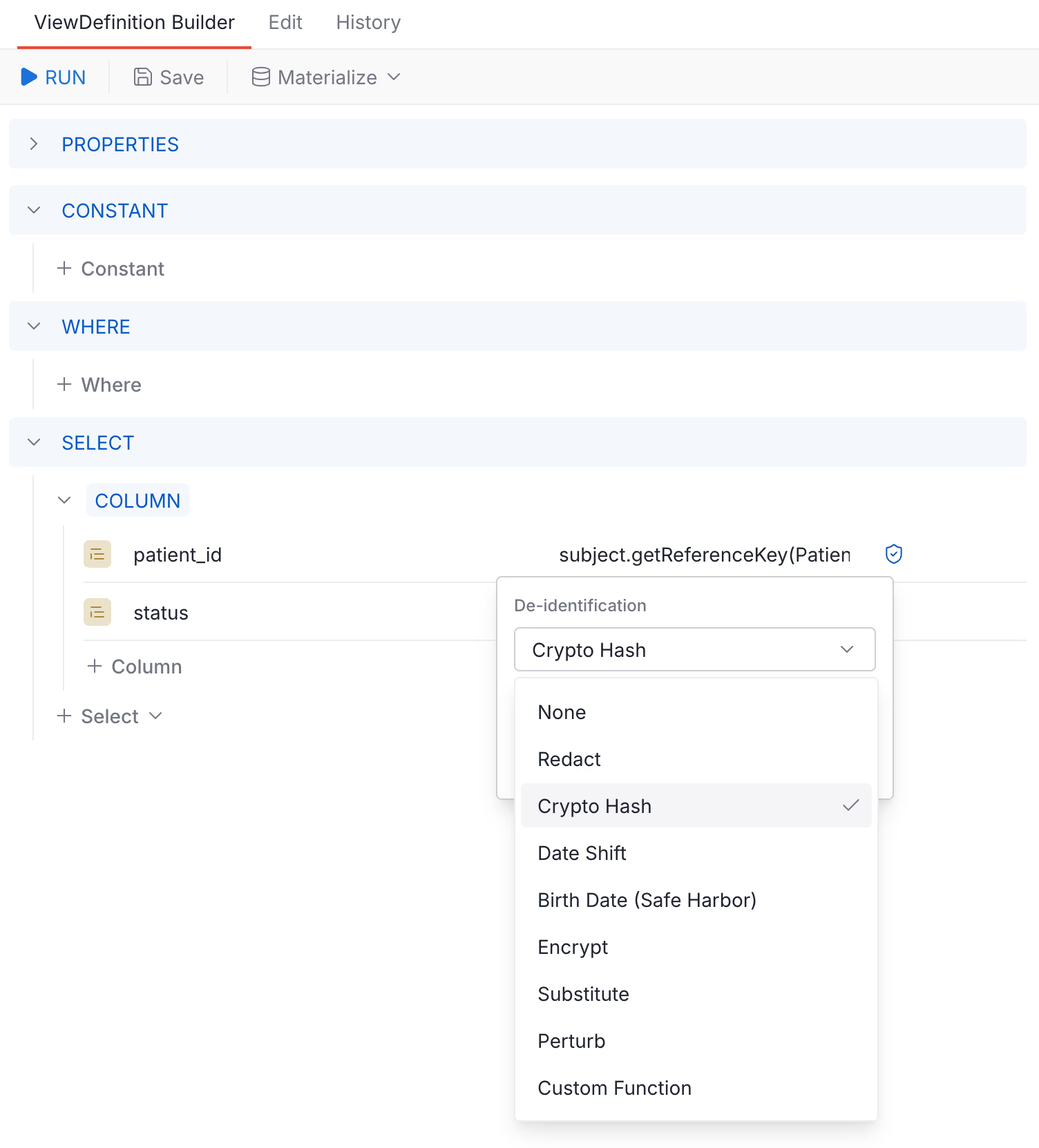
When a de-identification method is configured, the shield icon turns blue. Hovering shows the current method name.
Writing custom PostgreSQL functions
Custom functions referenced via custom_function must:
- Accept
textas the first argument (the column value) - Optionally accept a second argument of any type (passed via
custom_arg) - Already exist in the database before the ViewDefinition is executed
Example:
CREATE OR REPLACE FUNCTION my_mask(value text)
RETURNS text LANGUAGE sql IMMUTABLE PARALLEL SAFE AS $$
  SELECT CASE
    WHEN value IS NULL THEN NULL
    ELSE left(value, 1) || repeat('*', greatest(length(value) - 1, 0))
  END;
$$;
Then reference it in a column:
{
  "url": "http://health-samurai.io/fhir/core/StructureDefinition/de-identification",
  "extension": [
    {"url": "method", "valueCode": "custom_function"},
    {"url": "custom_function", "valueString": "my_mask"}
  ]
}
See also: