

Healthcare organizations increasingly recognize that while EHR systems excel at clinical workflows, they often fall short for advanced analytics, flexible interoperability, and rapid innovation. EHR vendor FHIR APIs implement only a fraction of the FHIR specification and impose significant limitations on performance, data access, and customization.
Independent FHIR servers like Aidbox complement existing EHR investments by providing a powerful data hub for use cases that EHR vendors cannot adequately support — from real-time analytics and AI testing environments to granular data sharing and advanced SMART applications.
Analytics: The Foundation of Data-Driven Healthcare
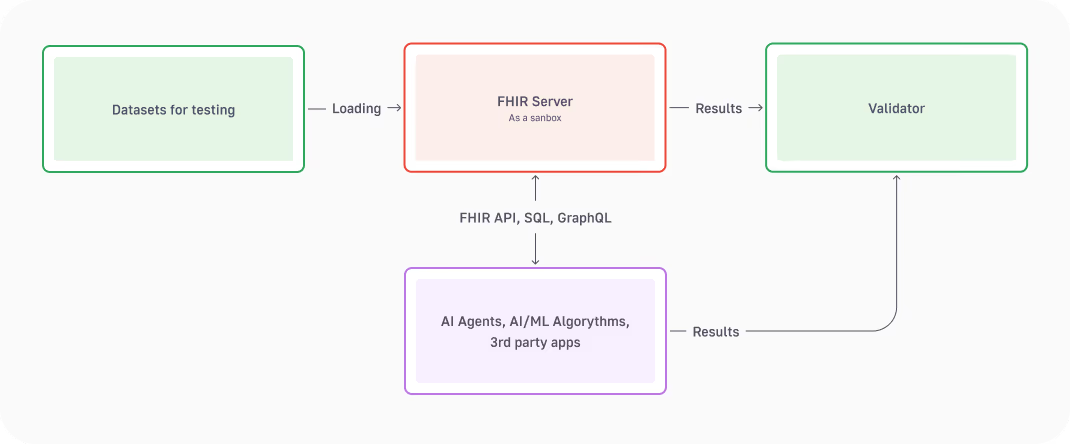
Independent FHIR servers transform healthcare analytics from a retrospective reporting exercise into real-time operational intelligence. While EHR vendor APIs struggle with basic query performance and warn against "constantly querying" their systems, and traditional data warehouses lag with updates every 24 hours or more, platforms like Aidbox handle thousands of requests per second with sub-100ms response times, enabling real-time analytics on terabyte-scale datasets.
Prenosis demonstrates this power with their FDA-authorized Sepsis ImmunoScore™, where ML algorithms process data from the FHIR database and return real-time sepsis predictions — as detailed in the case study Aidbox FHIR Platform for the Development of Immunix for Precision Medicine. Aidbox's SQL on FHIR capabilities simplify data transformations and enable analysts to use familiar SQL tools for population health insights, while also allowing organizations to leverage prebuilt transformations and SQL queries designed by other organizations. This performance advantage becomes critical as healthcare shifts toward value-based care contracts, where organizations need instant access to population health metrics, quality measures, and cost analytics to optimize patient outcomes and financial performance.
Prenosis reduced development time by 50% using Aidbox's configurable APIs and FHIR storage with SQL support. Their system has processed over 75,000 patients and 6 million observations, achieved FDA clearance, and is now implemented in three hospitals. This demonstrates how real-time clinical decision support directly improves patient outcomes while reducing costs.
Sandboxing: The Innovation Laboratory for Healthcare AI
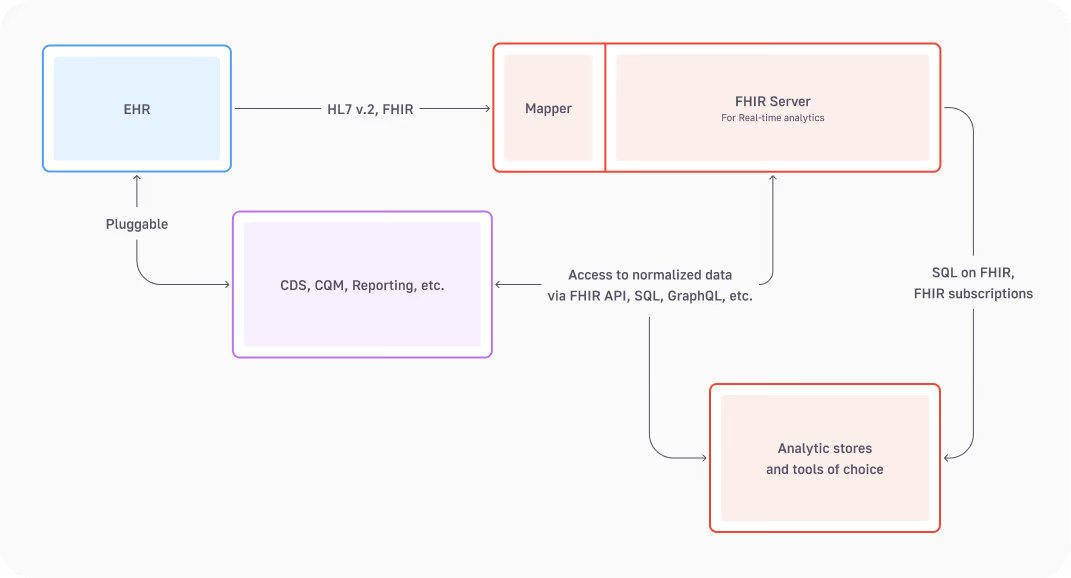
Healthcare AI testing requires safe environments where algorithms can be validated without risking patient safety. Most EHR sandbox environments don't let you create the specific test data you need - even something as simple as one patient with particular appointment times or medical conditions. Independent FHIR servers like Aidbox solve this problem by letting you create a sandbox with one click and load exactly the dataset you need for testing. You can build test scenarios with synthetic patients, de-identified data, or even challenging corner cases to ensure your AI algorithms work safely before going live.
This testing capability has become critical as the FDA requires strict validation of healthcare AI tools before deployment. With Aidbox, data scientists can experiment with machine learning models on realistic clinical scenarios while maintaining full audit trails and data governance. The one-click deployment from sandbox to production dramatically speeds up innovation - you can move from testing an algorithm to using it clinically in weeks instead of months. This is especially valuable for academic medical centers and large health systems that want to develop their own AI tools for clinical decision support and patient care, or participate in research partnerships that require rapid testing and validation.
Granular Data Sharing: Precision Interoperability for Modern Healthcare
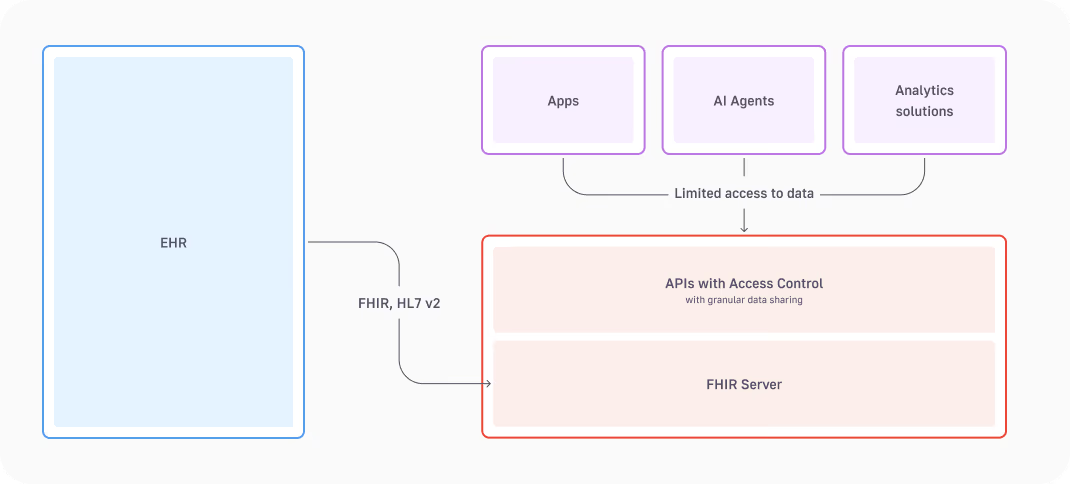
Traditional EHR FHIR APIs provide blunt instruments for data sharing, offering limited granular control over what information gets shared with whom and under what circumstances. Independent FHIR servers solve this critical limitation by enabling precise, policy-driven data sharing that meets both regulatory requirements and operational needs. Unlike Epic's or Cerner's APIs that implement only a fraction of FHIR standards and expose a small part of clinical data with limited ability to filter what specific data elements get shared with different users, platforms like Aidbox provide comprehensive granular permissions allowing organizations to share exactly the data needed for specific use cases while maintaining strict privacy controls. This capability proves essential for complex healthcare ecosystems where different partners, research collaborators, and care team members require access to different subsets of patient information.
While EHR vendors meet basic ONC certification requirements for data sharing, modern healthcare organizations need capabilities that go far beyond these minimum standards. Complex use cases like research collaborations, value-based care contracts, and multi-partner care coordination require precise control over data sharing policies that can be customized for different relationships and use cases. Independent FHIR servers enable organizations to implement sophisticated sharing rules while ensuring compliance with HIPAA, state privacy laws, and emerging regulations around patient data rights, providing the flexibility that healthcare organizations need for advanced interoperability initiatives.
SMART on FHIR: Powering Advanced Healthcare Applications
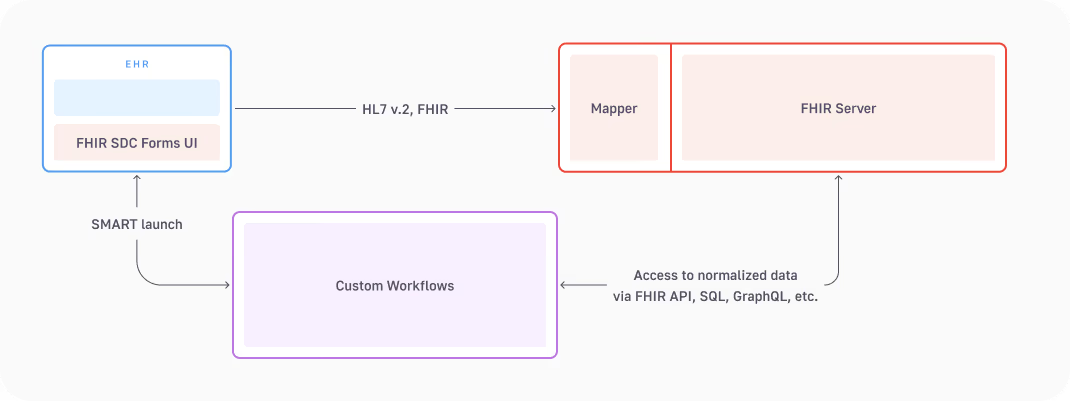
SMART on FHIR applications often require capabilities beyond what EHR systems can provide directly. Advanced healthcare apps often pull data from multiple sources - medical devices, lab systems, imaging platforms, patient surveys, and external databases. These apps also need to run complex queries, perform analytics, or provide decision support that requires powerful backend processing. Independent FHIR servers like Aidbox provide the ideal backend for these applications, especially as data from EHRs increasingly comes in FHIR format, with converters available for older formats like CCDA and HL7 v2.
Aidbox not only normalizes all the data to FHIR but also offers tooling for fast development of modern UI with no code. Aidbox Forms implement the FHIR SDC (Structured Data Capture) specification, which is a less well-known but powerful capability of the FHIR platform that enables sophisticated user interfaces for data collection and clinical workflows. This allows healthcare organizations to rapidly build custom forms, questionnaires, and data entry interfaces that seamlessly integrate with their SMART applications and automatically store data in standardized FHIR format. The combination of robust backend processing and intuitive form-building capabilities makes it possible to develop comprehensive healthcare applications that enhance clinical workflows without requiring extensive development resources.
Conclusion
Independent FHIR servers unlock capabilities that healthcare organizations need for modern data-driven care delivery but cannot achieve with EHR vendor APIs alone. The evidence demonstrates clear value: organizations like Prenosis have achieved FDA clearance with 50% development time reductions, while health systems gain the flexibility to innovate rapidly without disrupting clinical workflows. As healthcare continues its digital transformation, platforms like Aidbox provide the technical foundation necessary to participate in value-based care, AI-powered medicine, and next-generation interoperability initiatives while extending and amplifying existing EHR investments.
See also: About FHIR Facades.