
We are excited to announce the publication of the paper, SQL on FHIR - Tabular views of FHIR data using FHIRPath, in the journal npj Digital Medicine, part of the Nature Portfolio.
The work addresses a common challenge: FHIR data, typically exchanged as nested JSON or XML, is difficult to query and analyze directly due to its complexity and structure. The SQL on FHIR specification defines a standard, implementation-agnostic method for describing tabular views over FHIR resources using FHIRPath, making it easier to extract, transform, and analyze clinical data across platforms.
Key Features:
- Standardized view definitions using FHIRPath expressions
- Portability across multiple technology platforms and databases
- Simplified transformation of FHIR data into flat, tabular structures suitable for analytics
- Supports common use cases in clinical decision support, predictive analytics, and real-time alerting
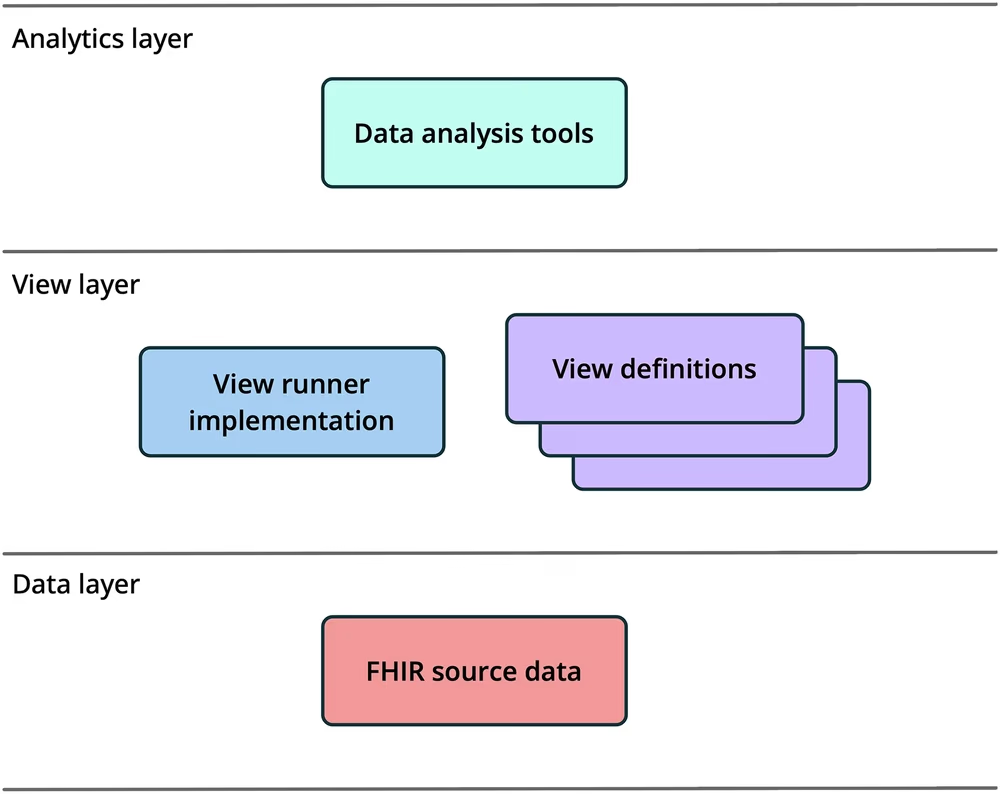 Architectural layers
Significance
This specification enables healthcare organizations, researchers, and vendors to reduce duplication of effort and inconsistency in FHIR data transformations.
What you’ll learn from the paper:
- Why FHIR data needs transformation: FHIR (Fast Healthcare Interoperability Resources) is now the preferred standard for health data exchange, but its nested JSON/XML structure makes analytics challenging.
- The SQL on FHIR solution: The paper presents a standard, reusable way to define “view definitions” that turn FHIR resources into flat, tabular data—making it easier to use with SQL, Python, R, Excel, and other analytics tools.
- How it works: You’ll discover how FHIRPath expressions power these tabular views, and how the approach balances simplicity, expressiveness, and portability for real-world use cases.
- Real-world validation: The specification was tested across multiple independent implementations and used to successfully replicate a published clinical study, demonstrating its feasibility and portability.
- Practical examples: The paper includes clear examples of view definitions, showing how to extract and structure data such as patient demographics or clinical observations for analytics.
- Future impact: Learn how this approach can reduce duplication of effort, increase consistency, and support regulatory requirements like the US 21st Century Cures Act and the European Health Data Space.
Collaborators and Support
The paper is a result of collaborative efforts from an international working group including Health Samurai, Google, CSIRO, Microsoft, Philips, and others. The group is actively driving early implementations to build a standardized, vendor-neutral solution with zero lock-in.
Meet the Authors and Contributors:
- Authors: John Grimes, Ryan Brush, Nikolai Ryzhikov, Piotr Szul, Joshua Mandel, Dan Gottlieb, Grahame Grieve, Bashir Sadjad, Arjun Sanyal.
- Special thanks to working group contributors: Gino Canessa, Igor Kislitsyn, Maxim Putintsev, Alexander Walley, Vadim Peretokin, Marat Surmashev, Brian Kaney, Carl Anderson, Kiran Ayyagari, Joel Montavon, Daniel Kapitan, Brian Postlethwaite, Steve Munini, Martijn Harthoorn, Ward Weistra, Adam Culbertson, Joshua Kelly.
Additional Resources
- Read the full paper: npj Digital Medicine, DOI: 10.1038/s41746-025-01708-w
Further Reading by Nikolai Ryzhikov, Health Samurai’s CTO:
-
SQL on FHIR in PostgreSQL Dive into the practical implementation of SQL on FHIR using PostgreSQL, exploring real-world use cases and performance considerations.
-
What is a ViewDefinition? Understand the core concept of ViewDefinition—how it enables standardized, reusable tabular views of FHIR data for analytics and interoperability.
-
SQL on FHIR: An Inside Look Get an insider’s perspective on the development, challenges, and future of SQL on FHIR, directly from the project’s technical leadership.
Health Samurai’s SQL on FHIR engine is available for preview and testing. For inquiries and demonstrations, please contact Health Samurai via the contact form below.
