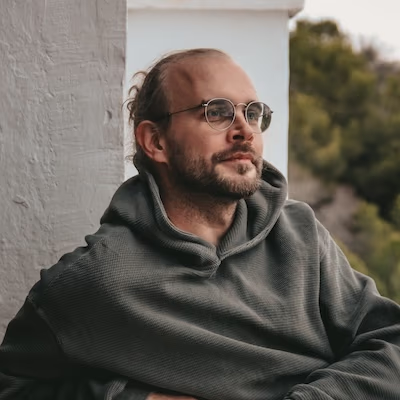
During FHIR Camp 2024 in Portugal, Kurt Johnson, an integration architect and writer, engaged with various experts on topics related to FHIR and healthcare technologies. In this episode, he spoke with Grahame Grieve, the founder of FHIR (Fast Healthcare Interoperability Resources). They discussed the importance of community in healthcare data sharing and the future of FHIR.
Watch the Youtube playlist featuring interviews with Nikolai Ryzhikov, Gino Canessa, Lloyd McKenzie, Ewout Kramer, and Maria Manuel Salazar, or read the summary below.
Q1: Grahame, it’s great to have you here at FHIR Camp! Why are events like this important for the FHIR community?
Grahame Grieve: Thanks, Kurt! From the beginning, one of the main focuses of building FHIR was to create an active community. The primary challenge we face is a people problem—getting individuals skilled up and enthusiastic while ensuring they have the right connections to solve their problems. Events like this are invaluable because they provide a fantastic learning and networking environment, especially for developers.
Q2: Yesterday, there was a nostalgic discussion about the early days of FHIR and late-night hacking sessions. Do you think there’s a tension between the success of FHIR and maintaining that enthusiasm as the community grows?
Grahame Grieve: It’s not so much about maintaining enthusiasm; it’s about evolving what we’re enthusiastic about as our projects progress. Personally, I thrive in the early phases of projects but recognize that we need to see things through to completion. While I miss those innovative and risky early days, we’ve reached a point where we must ensure that FHIR succeeds and meets expectations.
Q3: Is there an emerging standard toolset for implementers, or does FHIR inherently embrace diversity?
Grahame Grieve: We’re witnessing convergence around several toolsets and ecosystems driven by various goals and corporate cultures. It’s beneficial that we’re not converging on a single toolset or architectural approach. Since interoperability involves exchanging data between different systems, having multiple solutions helps people tackle their specific challenges effectively.
Q4: There seems to be a shift in opinion regarding AI's role in digital health and interoperability. What are your thoughts on this?
Grahame Grieve: AI certainly has a role in digital health. Currently, it excels in summarization and communication—transforming complex technical documents into accessible summaries. However, when it comes to diagnosis or monitoring health processes, AI isn’t quite there yet. I suspect we’ll need more data to address healthcare’s complexities, especially since the most challenging cases often involve intricate details.
Q5: You previously mentioned that keeping FHIR free and open source was crucial for low-resource settings. Is this still a primary concern?
Grahame Grieve: Absolutely! Ensuring that FHIR remains accessible is vital. Progress has been slower than I hoped in lower-middle-income countries due to their healthcare systems' maturity levels. However, it's essential that these regions can adopt FHIR without financial barriers. When I speak with implementers in Africa, they emphasize the importance of not having to secure funding to use the standard.
Q6: What excites you about the future of FHIR in 2025?
Grahame Grieve: I’m particularly excited about seeing growth in Africa—it seems to be gaining momentum! I look forward to finalizing the next major release of FHIR; while it will be challenging, it will be rewarding. Additionally, I am eager to see implementation work around Interoperable Patient Solutions (IPS) and patient empowerment continue to expand. The digital health landscape is evolving rapidly, and it feels like there’s no limit to how far we can go.
Aidbox FHIR Server licenses for all
Get free Aidbox development licenses to bring your FHIR ideas to life. These licenses never expire but come with a 2 GB DB size limit and are for working with synthetic data only (no PHI). Perfect for deep dives into FHIR, participating in FHIR Connectathons, and running POCs.
// Get a free Aidbox dev license
See also: Getting Ready for FHIR R6 and FHIR R4 vs FHIR R5.